In the modern metal beneficiation industry, “more crushing, less grinding” is no longer just a slogan but a core strategy determining the success or failure of an enterprise. It is well known that the grinding stage in the beneficiation process accounts for over 60% of the total energy consumption of the entire plant, along with significant steel ball consumption. Therefore, how to reduce the ore particle size further and more uniformly during the front-end crushing stage, while creating micro-cracks conducive to subsequent liberation, has become the key to improving recovery rates and reducing comprehensive costs. Hydraulic roll crushers (especially high-pressure models), with their superior “adaptability” and “controllability,” are sparking a technological revolution in various metal mines, including gold, iron, and molybdenum mines.

Pebble Sand Making Machine
1. Conquering Hard Rock: The Versatile Nemesis for Gold, Iron, and Molybdenum Ores
The wide variety and differing properties of metal ores pose significant challenges to crushing equipment.
Iron Ore: Typically characterized by high hardness and strong abrasiveness (e.g., magnetite, hematite), causing rapid wear of liners in traditional cone crushers. Hydraulic roll crushers utilize high-chromium manganese steel alloy or tungsten carbide composite roller skins, achieving surface hardness above HRC 62. Their wear resistance is 3-5 times that of ordinary high-manganese steel, allowing them to easily handle the highly abrasive conditions of iron ore.
Gold Ore: Much gold is encapsulated in quartz veins or sulfides, requiring sufficient liberation to improve leaching or flotation recovery rates. The unique “laminated crushing” principle of hydraulic roll crushers generates abundant micro-cracks within the ore during crushing, significantly promoting the liberation of valuable minerals from gangue. This creates superior conditions for subsequent cyanidation or flotation processes.

Molybdenum Ore: Molybdenum ore often has complex associations and exhibits brittleness. The compression crushing method of the roll crusher effectively avoids over-crushing, protecting molybdenum minerals from sliming, thereby significantly enhancing concentrate grade and recovery rates.
Whether it’s high-hardness iron ore, tough gold-copper ore, or brittle molybdenum-lead-zinc ore, the hydraulic roll crusher, with its powerful compressive force (reaching hundreds of megapascals), conquers them all, truly achieving “one machine, multiple uses, universal for hundreds of ores.”
2. Granularity at Your Command: The Flexibility of Customizable Output Fineness
Beneficiation processes are complex and variable. Different ores and different stages of processing have entirely different requirements for feed particle size to the mill. Once traditional crushing equipment is set, adjusting the particle size often requires replacing liners or screens, which is time-consuming and labor-intensive. Hydraulic roll crushers break this limitation, granting concentrators an unprecedented level of control.
The equipment is equipped with a high-precision fully automatic hydraulic gap adjustment system. Operators simply input the target parameters on the touchscreen in the control room, and the hydraulic station responds within milliseconds, accurately controlling the gap between the two rollers.
Coarse Crushing Needs: The roller gap can be widened to process larger run-of-mine ore, serving as a secondary crushing stage.

hydraulic roller crusher
Fine Crushing Needs: The roller gap can be narrowed to 1-3mm or even finer, directly producing fine material close to mill feed requirements, achieving “crushing instead of grinding.”
Dynamic Adjustment: When ore hardness or moisture content changes, the system can automatically compensate pressure in real-time, maintaining a constant output particle size.
This capability of “setting the output fineness yourself” allows concentrators to flexibly adjust their process routes based on market conditions and ore characteristics without stopping the machine to replace parts, greatly enhancing production flexibility and adaptability.
3. Cost Reduction and Efficiency Increase: Substantial Gains from the Micro-Crack Effect
The value of a hydraulic roll crusher lies not only in reducing the size of the rock but also in altering the physical structure of the ore. Under high-pressure compression, a large number of visible or invisible micro-cracks are generated inside the ore particles. This “damage accumulation” effect significantly reduces the Bond Work Index of the ore, meaning the ore becomes “softer and more friable.”
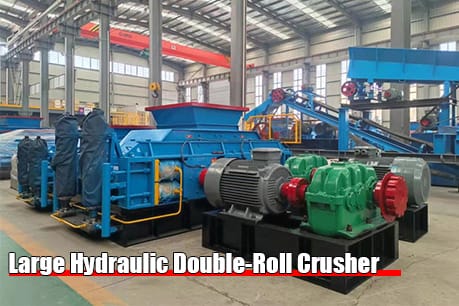
Hydraulic Roller Crusher
Data indicates that after pretreatment with a hydraulic roll crusher, the ore entering the ball mill can see grinding efficiency increase by 30%-50%. Hourly throughput increases substantially, while power consumption and steel consumption decrease significantly. For a large concentrator with a daily throughput of tens of thousands of tons, annual savings on electricity alone can amount to millions of dollars. Coupled with the additional metal revenue from improved recovery rates, the return on investment period is often shortened to 1-2 years.
4. Intelligent Protection: Dual Guarantees of Safety and Stability
To handle uncrushable objects often found in metal ores, such as iron pieces or wood chips, the hydraulic roll crusher incorporates a sensitive overload protection system. Upon detecting abnormal pressure, the rollers automatically retreat to release the foreign object and then instantly reset. This not only protects the core components of the main unit from damage but also avoids the hassle of stopping for cleaning. Furthermore, the fully enclosed structural design effectively controls dust emissions and operates with low noise, fully complying with the environmental requirements of green mines.

Conclusion
For concentrators pursuing maximum efficiency, introducing a hydraulic roll crusher is not just an equipment upgrade but an enhancement of process philosophy. With its powerful ability to handle gold, iron, and molybdenum ores, the flexibility of freely adjustable output fineness, and significant effects in energy saving and production increase, it has become the optimal choice for modern concentrators to reduce costs, increase efficiency, and enhance core competitiveness. In an era of increasingly complex and lean mineral resources, whoever masters more efficient crushing technology will stand invincible in the fierce market competition.