In the aggregate industry, the characteristics of materials determine the choice of equipment. Faced with the high hardness of quartz (Mohs hardness 7) and the high abrasiveness of river pebbles, traditional hammer crushers often cause headaches for owners due to fast hammer wear and frequent replacement; impact crushers tend to have high operating costs due to significant plate hammer consumption. However, with the innovation of crushing technology, a hydraulic roll sand making machine that offers flexible customization from 20 to 200 tons per hour and is specifically designed for hard rock is becoming the “new favorite” among many sand plant owners. It not only solves the hard rock crushing problem but also redefines the standard for low operating costs with its outstanding performance of “roller skins durable for over 2 years.”
1. Full Capacity Coverage: From 20 to 200 Tons, There’s a Model for You
Many equipment manufacturers, for the sake of standardized production, often only offer fixed models, leading users to either have an “underpowered” machine struggling to work or an “overpowered” machine wasting investment. This hydraulic roll sand making machine breaks this deadlock by offering a full series of models ranging from 20 to 200 tons per hour.
Ideal for Small Startups (20-50 tph): Suitable for newcomers, those with limited space, or processing construction waste recycling. The machine is compact, requires low investment, offers quick returns, and can be implemented with a budget of around 300,000 RMB.
Mainstay Medium Model (60-120 tph): Suitable for most formal sand and gravel plants, capable of stably supplying nearby mixing stations. It represents a golden segment with high cost-performance.
Large Production Lines (150-200+ tph): Features dual-motor drive and a reinforced frame, allowing multiple units to be connected in parallel to form large production lines, meeting the sand demand for major infrastructure projects.
No matter your scale, you can find a matching model, eliminating resource waste and turning every bit of investment into productivity.
2. Hard Rock Nemesis: Specifically Crushes Quartz and River Pebbles, Excellent Particle Shape
Quartz and river pebbles are公认 as “tough nuts to crack.” When ordinary equipment processes these materials, not only does wear occur quickly, but it also tends to produce flaky particles that affect concrete strength.
This hydraulic roll crusher uses two counter-rotating high-hardness rollers to apply high-pressure compression and shear crushing to the material.
For Quartz: The powerful extrusion force instantly disintegrates the high-hardness crystals. Due to laminated crushing, the resulting sand has fewer internal cracks and higher strength.
For River Pebbles: The unique crushing chamber design effectively overcomes the disadvantages of the pebbles’ smooth surface (difficult to grip), resulting in high crushing efficiency.
More importantly, the finished sand has a cubic shape, reasonable gradation, and an adjustable fineness modulus. It can completely replace natural river sand, commanding higher selling prices and facing significant market demand.
3. Core Advantage: High-Chromium Alloy Roller Skins, Durability Exceeds the 2-Year Mark
“Able to afford buying, unable to afford repairing” is a common problem with hard rock crushing equipment. However, the core highlight of this machine lies in its specially made high-chromium alloy wear-resistant roller skins.
Through special metallurgical formulas and heat treatment processes, the surface hardness of these roller skins reaches HRC 60-65 with good toughness. In actual working conditions:
Crushing Quartz: Ordinary high-manganese steel roller skins might wear flat in a week, while high-chromium alloy skins can last for months or even over half a year.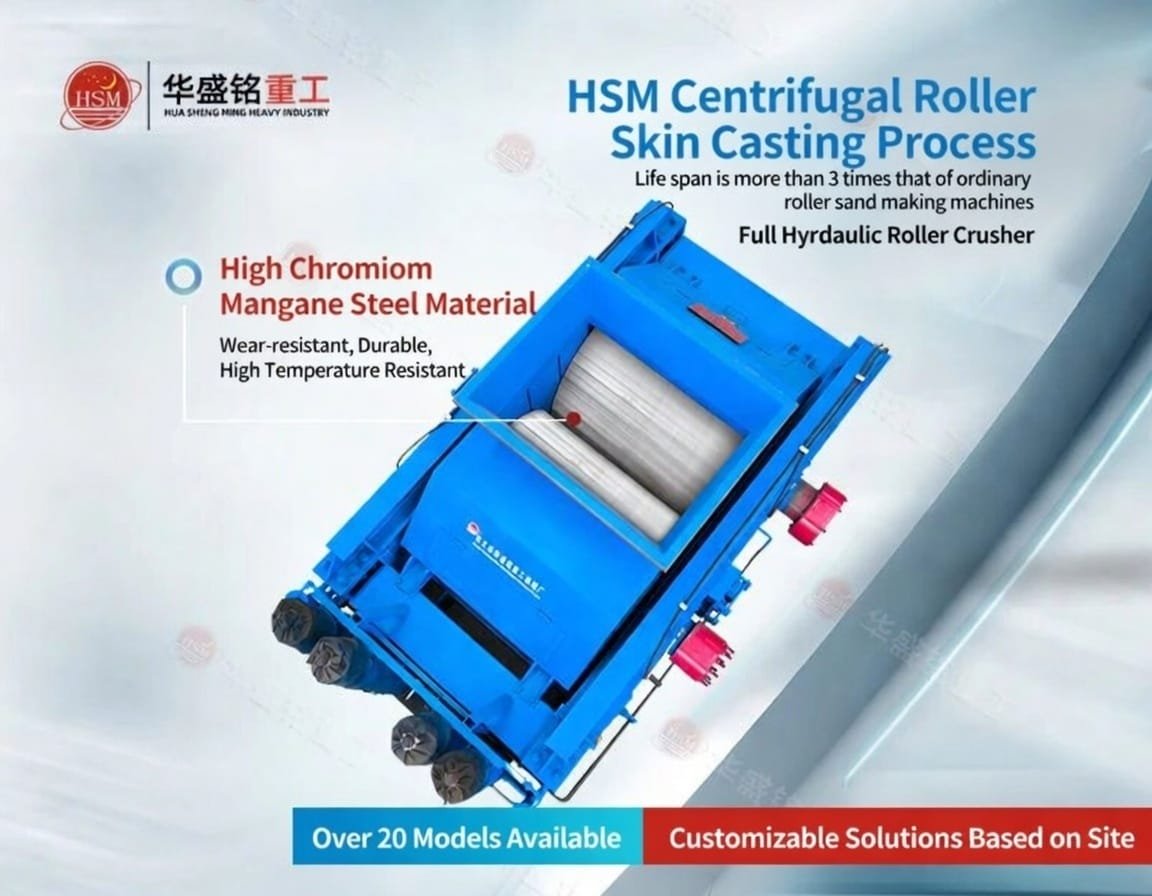
Crushing River Pebbles: Under normal maintenance, a set of high-quality roller skins can easily last over 2 years (depending on specific output and material mud content).
What does this mean? It means you won’t need to purchase new roller skins for two years, won’t need frequent shutdowns for hardfacing repairs. You save not only tens of thousands in parts costs but also hundreds of hours in downtime costs. For a sand plant with a daily output value of tens of thousands, no downtime equals significant profit.
4. Intelligent Hydraulics: Overload Protection for Worry-Free Operation
Besides wear resistance, safety is equally crucial. The equipment comes standard with a fully automatic hydraulic adjustment and overload protection system. When uncrushable objects (like iron blocks) enter the chamber or when the feed is too large, the hydraulic system automatically increases the roller gap to expel the foreign object and then immediately resets. This not only avoids serious accidents like shaft breakage or motor burnout but also enables stepless adjustment of the discharge particle size. It is easy to operate, allowing one person to control the entire process.
Conclusion
In an era of thin profits, controlling costs is creating profits. This hydraulic roll sand making machine, with options from 20 to 200 tons per hour, specifically designed for crushing quartz and river pebbles, and featuring roller skins durable for over 2 years, is becoming a benchmark in the hard rock crushing field with its superior wear resistance, flexible capacity configuration, and intelligent operation system.
If you are troubled by high wear parts costs or headaches from frequent equipment failures, consider upgrading to this “long-lasting money printer.” Choosing it means choosing stability, high efficiency, and long-term wealth returns. Don’t let outdated equipment slow down your path to profit. Act now and start your era of low costs and high output!