As a high-hardness, wear-resistant material widely used in construction and decoration, raw granite blocks require crushing equipment for processing. Among various options, the jaw crusher is favored as the primary crushing equipment for granite due to its stable performance, strong capacity and wide adaptability.
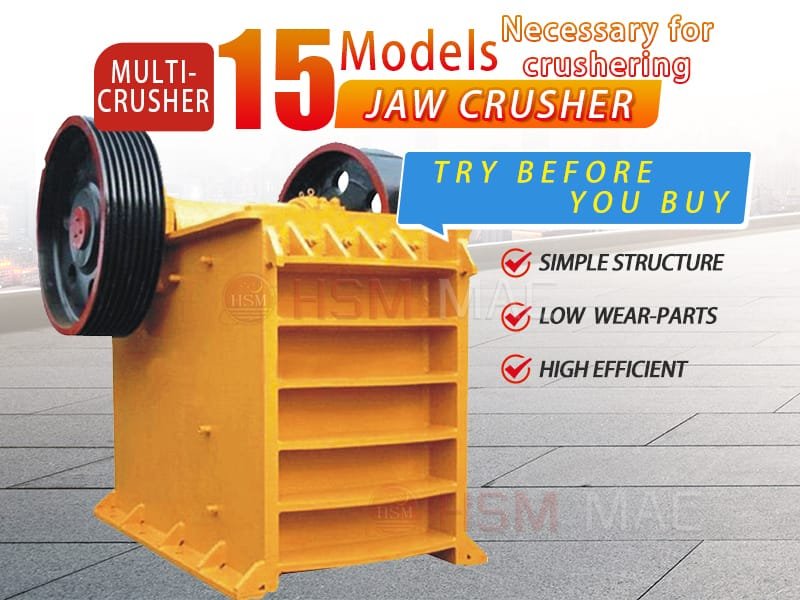
How Does a Jaw Crusher Work for Granite?
The jaw crusher adopts an extrusion crushing mechanism, consisting of fixed and movable jaw plates, and an eccentric shaft. Driven by the motor, the eccentric shaft makes the movable jaw plate swing reciprocally: when approaching the fixed one, it crushes granite blocks; when moving away, the crushed particles fall from the discharge port, realizing continuous crushing.
Why Is Jaw Crusher the First Choice for Granite Crushing?
With a Mohs hardness of 6-7, granite demands wear-resistant and high-capacity crushing equipment. The jaw crusher becomes the top choice for its unique advantages:
Strong Capacity & High Efficiency: Equipped with a deep crushing cavity and large feed port, it handles large granite blocks (max feed size up to several meters) and achieves an hourly output of hundreds to thousands of tons, suitable for both small and large-scale projects.
Excellent Wear Resistance: Its core wearing parts (jaw plates) are made of high-manganese or alloy steel. With a reasonable lubrication system, it has a long service life even when crushing high-hardness granite.
Wide Adaptability: It can crush granite, basalt and other high-hardness materials. As primary crushing equipment, it can combine with cone crushers to form a complete production line for different particle size requirements.
Easy Maintenance: With a simple structure and few wearing parts, it allows quick replacement of components. Ordinary workers can master its operation after simple training.
Practical Application Scenarios of Jaw Crusher in Granite Processing
The jaw crusher plays an irreplaceable role in granite processing, with typical application scenarios:
Quarry Primary Crushing: It crushes 1-3m raw granite blocks into 50-200mm medium particles, providing qualified materials for subsequent processing.
Construction Aggregate Production: Its crushed granite can be processed into aggregates for highways, railways and high-rise buildings, ensuring project quality with uniform particle size and high compressive strength.
Stone Processing: It crushes large blocks into small pieces for cutting and polishing, which are then made into decorative stones like floor tiles and countertops.
Key Tips for Choosing a Jaw Crusher for Granite Crushing
Key factors to consider when selecting a jaw crusher for granite crushing:
Feed & Discharge Requirements: Clarify the max raw block size and required discharge particle size to select the right model.
Production Capacity: Choose the model based on hourly/daily output needs, noting that capacity is affected by granite hardness and humidity.
Quality & After-Sales: Select regular manufacturers with reliable quality and perfect after-sales services (installation, maintenance training, wearing parts supply).
In summary, the jaw crusher is a classic and efficient granite crushing equipment. With the growth of construction and mining industries, it will be further optimized to support the industry. For questions about selection, use or maintenance, welcome to leave comments for quick replies.