Designing a manufactured sand (M-sand) plant around a double roll crusher involves much more than selecting a single machine. This article explores complete plant architecture, detailing the standard three-stage layout (jaw, cone, and roll crusher), closed-circuit screening principles, parallel unit scaling for maintenance redundancy, and the total cost-efficiency advantages of compression crushing over impact systems for Huashengming (HSM) Heavy Industry clients.
When buyers search for a double roll crusher for a sand-making plant, they rarely question whether the machine can actually make sand—they already know it can. Their core question is how to engineer an entire plant around it that hits strict sand grading specifications, runs continuously without bottlenecks, and delivers a rapid return on investment. This guide addresses essential plant-design parameters: crusher placement, closed-circuit screening loops, capacity scaling, and critical pre-order decisions 【Custom Parameters Available】.
Note: Capacity and gradation figures are indicative reference values; final plant design is confirmed against your specific rock type, target sand specifications, and site conditions.

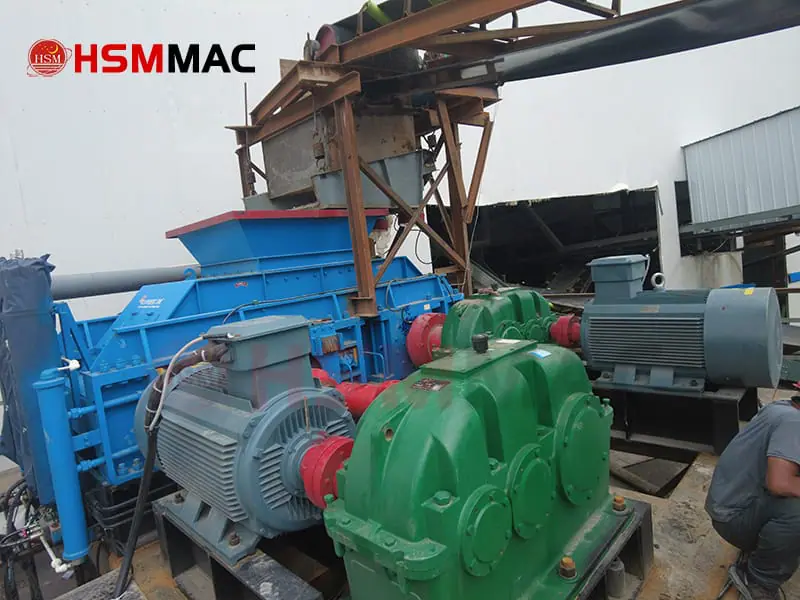
Complete M-Sand Plant Layout Featuring HSM Double Roll Crusher
1. The Standard Three-Stage M-Sand Plant Layout
Standard Proven Flowsheet:
Vibrating Feeder $rightarrow$ Jaw Crusher (Primary Coarse Reduction) $rightarrow$ Cone Crusher (Secondary Medium Reduction) $rightarrow$ Double Roll Crusher (Tertiary Fine Crushing & Shaping) $rightarrow$ Circular Vibrating Screen $rightarrow$ (Optional) Sand Washer $rightarrow$ Product Manufactured Sand.
Why Upstream Stages Matter:
The double roll crusher represents the final crushing step, never the first. It functions strictly as fine-crushing machinery, relying on primary jaw and secondary cone stages to execute heavy size reduction. Feeding raw, uncrushed hard rock straight into a double roll crusher is the single most common design error in small aggregate plants; it overloads fine-reduction mechanisms and accelerates roller shell wear. The three-stage layout is mandatory engineering practice that unlocks the roll crusher’s low-wear, low-fines advantages.
2. Closing the Circuit — The Correct Way to Hit Tight Specifications
A double roll crusher establishes product top sizes at the roll gap setting. However, tightening the inter-roll gap is never the correct method to chase tight grading specifications—pinching the gap forces throughput to drop sharply.
- Screen Oversize Returns: Oversized particles separated by the vibrating screen are recirculated back to the double roll crusher for a secondary pass.
- Screen Undersize Becomes Product: Qualified sand passing the screen flows directly to storage or washing.
- Healthy Roll Gaps Maintained: The gap remains at an optimal operational setting while the vibrating screen enforces the final cut.
This fundamental design principle protects both plant throughput capacity and roller shell longevity. Plants attempting to “pinch” roll gaps instead of closing screening loops frequently encounter severe tonnage shortages 【Custom Parameters Available】.
3. Scaling Capacity: Parallel Roll Crushers
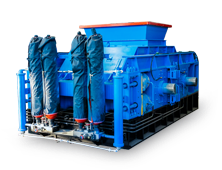
Rather than relying on a single oversized crushing unit, modern medium-to-large M-sand plants scale capacity by deploying two or more double roll crushers in parallel at the fine-crushing stage:
- Maintenance Redundancy: A plant targeted at 200 T/H can operate dual 2PGY1500×1200 units running at mid-range capacity, allowing one machine to undergo scheduled maintenance while the second carries production.
- Flexible Sizing: Parallel units allow operators to configure distinct roll gaps on each machine, producing two separate sand fractions simultaneously from a single plant layout.
4. Why a Roll-Crusher Plant Costs Less to Run
- Lower Energy Consumption: Low-speed compression comminution eliminates high-speed rotor windage and kinetic losses. Electrical power represents the second-largest operating cost after rock supply, and roll crusher efficiency compounds hour after hour.
- Reduced Wear Costs: Roller shells wear uniformly and are replaced individually without hourly hammer overhauls, representing a slow, predictable, and planned maintenance expense on medium-hard rock.
- Superior Fines Control: The “crush-to-size-and-exit” mechanism keeps stone powder generation low by design, ensuring sand washers or dust-return systems act as trim controls rather than emergency recovery measures.
- Excellent Particle Shape: Cubical manufactured sand grains with low flakiness indices satisfy commercial concrete workability standards without requiring extra cement paste 【Custom Parameters Available】.

HSM Crusher Setup