Industry Guide
How to Choose the Right Industrial Coal Crusher Machine
A Technical Guide to Eliminating Clogging and Controlling Fines Generation
Key Technical Challenges in Coal Handling Plants
Whether your processing line deals with raw bituminous coal, hard anthracite, or high-moisture coking coal, selecting the wrong crushing machinery can severely damage your bottom line. Mineral plants face three persistent bottlenecks: **excessive fine dust generation (over-crushing)**, **screen blinding or chamber clogging** caused by sticky wet coal, and **costly downtime** in continuous power generation setups.
To overcome these operating limits, a growing number of modern preparation facilities are replacing outdated hammer mills with high-capacity **Hydraulic Double Roller Crushers**.
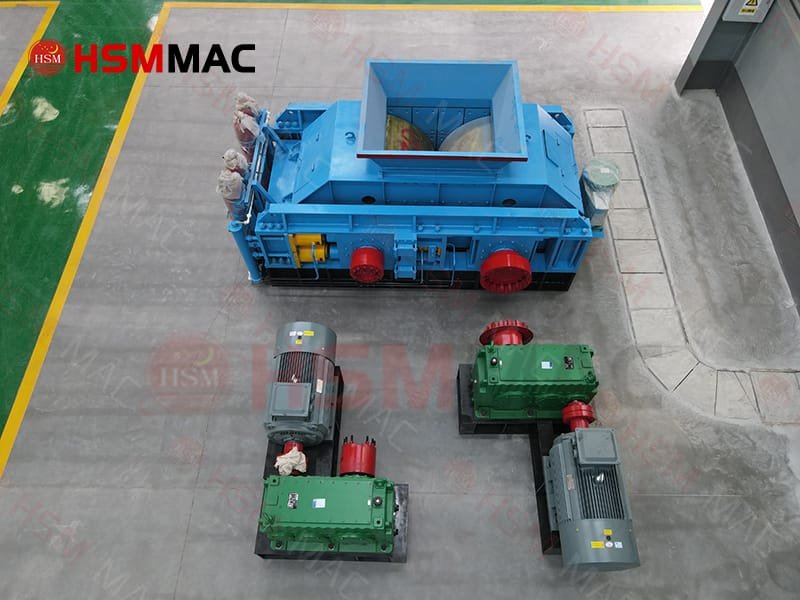
Hydraulic Double Roller Crusher
Double Roller Coal Crusher: Compression-Based Particle Sizing
The core efficiency of this system relies on the **synchronized compression-extrusion mechanism**. Instead of utilizing violent impact forces that violently shatter the fuel matrix into unwanted, unsellable slack dust, two heavy-duty rollers counter-rotate at optimized speeds, drawing the mineral feed downward and applying a calculated, steady squeeze.
By cleaving the coal aggregates directly along their natural internal shear planes, the machine guarantees high dimensional accuracy. The result is a highly predictable, cubic product distribution with negligible fines, creating the perfect calibrated feed size for fluidized bed boilers and gasification vessels.

How hydraulic cylinders maintain constant pressure to define the final product size
Why Roll Crushers Deliver Higher Efficiency in Coal Prep Plants
• Elimination of Material Buildup & Over-Pulverization
The active low-speed rolling action prevents the destructive tearing common in old ring hammer units. When processing wet, washed raw coal, the relentless rotation sweeps the crushing cavity clean, preventing packing and material buildup.
• High-Throughput Performance with 30% Lower Power Costs
Combining intelligent variable displacement hydraulics with high-torque drives boosts overall t/h capacities by 30% while reducing net energy costs by 20% to 30% compared to traditional secondary mill stages.
• Automatic Tramp Material Release Loop
Run-of-mine coal frequently contains roof bolts, non-magnetic metals, or heavy timbers. The integrated smart PLC pressure control instantly shifts the floating roll backward to reject the uncrushable tramp material, auto-resetting to keep production moving.
• Dust-Tight Enclosure for Environmental Compliance
Fugitive coal dust presents major safety and regulatory hurdles. The strictly sealed external framing minimizes dust emission at the source, helping your facility meet rigorous modern health, safety, and eco-regulations.
2PGY Heavy-Duty Coal Crusher Specifications & Parameters
| Model Code | Roll Dimensions (D×W) | Max Feed Size | Throughput Capacity | Total Motor Power |
|---|---|---|---|---|
| 2PGY1000×1000 | φ1000×1000 mm | ≤ 60 mm | 80 – 100 t/h | 2 × (75-90) kW |
| 2PGY1500×1200 | φ1500×1200 mm | ≤ 120 mm | 150 – 200 t/h | 2 × (132-160) kW |
| 2PGY2000×1200 | φ2000×1200 mm | ≤ 120 mm | 300 – 400 t/h | 2 × (315-355) kW |

Operational Coal Preparation Site
Optimize Your Coal Sizing Process Today
Consult with HSM application engineers to custom-configure teeth profiles and hydraulic systems matching your material properties.