Granite sand-making clients eventually face a universal question: with stone so hard, which equipment delivers the most cost-effective manufactured sand? While impact crushers, hammer crushers, and cone crushers all produce sand, double roll sand makers offer irreplaceable advantages in granite processing. This article examines the core hard-rock benefits of low-speed compression comminution—including superior cubical particle shape, minimal over-crushing, low per-ton power consumption, and hydraulic tramp protection—alongside a comparative performance breakdown, multi-stage plant configuration guidelines, and essential parameters required for custom Huashengming (HSM) engineering proposals.
Clients entering granite sand production inevitably arrive at the same pivotal question: With stone this hard, what equipment offers the most cost-effective sand-making performance? Impact crushers, hammer mills, and cone crushers are all capable of producing sand, yet double roll sand makers demonstrate distinct, irreplaceable advantages when processing granite. This article thoroughly explores those operational reasons.

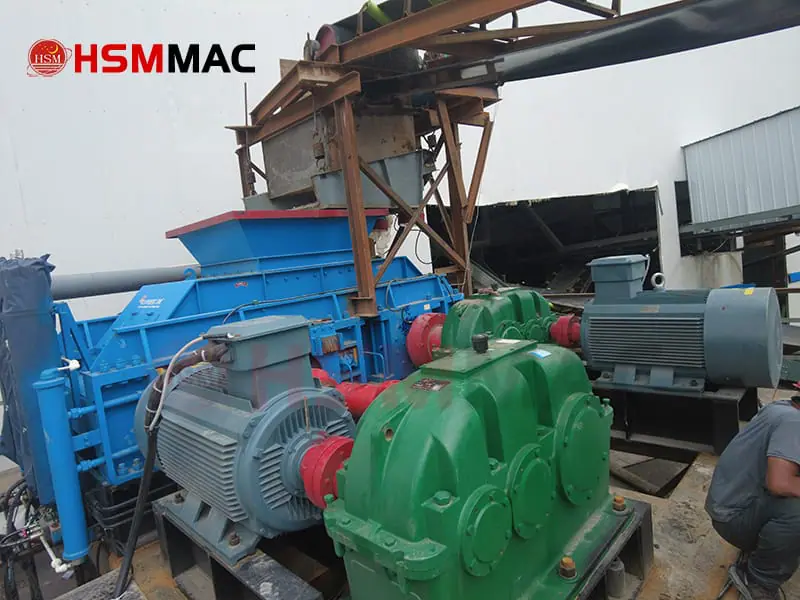
HSM Hydraulic Double Roll Sand Maker Operating in a Granite Plant
1. Conclusion First: Three Irreplaceable Strengths in Hard-Rock Processing
Granite features a Mohs hardness of 6–7, high abrasiveness, and elevated crushing resistance indexes. Hard-rock processing plants typically dread three major headaches: poor particle shapes that lower market value, excessive stone powder generation that wastes raw material revenue, and heavy electricity and consumable part expenses that erode profit margins. The roll-pressing mechanism of double roll sand makers directly provides the correct engineering solution to all three:
- Low-Speed High-Pressure Compression vs. High-Speed Impact: Yields superior cubical particle shapes with minimal over-grinding.
- Single-Pass Comminution & Immediate Discharge: Delivers high finished product yield with controllable stone powder ratios.
- No High-Speed Rotors & Low Per-Ton Power Consumption: Keeps long-term operating costs strictly under control.
2. Seven Detailed Reasons Driving Mainstream Granite Adoption
- Superior Particle Shape (The Most Valuable Asset): Granite manufactured sand is primarily supplied to commercial batching plants and high-grade concrete projects where particle shape and gradation are strict quality thresholds. Compression crushing yields cubical and near-cubical particles with significantly lower needle-flake ratios than hammer or impact crushers. This improves concrete workability, eliminating the need to add extra cement to compensate for poor shape—saving substantial cement costs annually for a 100,000-ton plant 【Custom Parameters Available】.
- Single-Pass Comminution & High Yield: Operating on a “sufficiently crushed, immediately discharged” logic, material exits the nip as soon as it reaches the roll gap size without being subjected to repetitive high-speed impacts. In hard rock, this translates to more finished sand and less waste dust compared to impact crushers.
- Lower Per-Ton Electricity Costs: Low rotational speeds without high-speed rotors significantly reduce specific energy consumption ($kWh/t$). Given granite’s high crushing resistance, electricity represents a major operating expense; every reduction in power draw directly expands profit margins.
- Hydraulic Overload Protection Against Tramp Iron: Stray excavator teeth, rebar ends, and drill bits mixed into granite quarries are safely managed by hydraulic accumulators, which allow active rollers to retract automatically and reset after discharging impurities—preventing roller shell cracking and main shaft damage. Preventing unplanned downtime saves far more than the cost of replacement parts.
- Adjustable Sizing for Flexible Production: Simple inter-roll gap adjustments allow seamless switching between coarse and medium sand specifications on the same machine, granting plants the flexibility to fulfill diverse client orders without changing parts or halting operations.
- Enclosed Dust Control & Environmental Compliance: Fully sealed crushing chambers and direct dust collection duct connections keep ambient particulate levels low, helping plants easily pass environmental inspections.
- Simple Maintenance & Independent Servicing: Lacking high-speed rotors and complex internal mechanisms, routine work is limited to checking roll gaps and lubricating bearings. Worn roller shells can be replaced independently without overhauling the machine, which is critical for remote project sites.
3. Performance Comparison with Alternative Crushing Equipment
| Comparison Metric | Double Roll Sand Maker | VSI Impact Crusher | Hammer Crusher |
|---|---|---|---|
| Crushing Principle | Low-speed compression & shear | High-speed impact (rock-on-rock / rock-on-iron) | High-speed hammer pounding |
| Granite Particle Shape | High cubical content, low needle-flake | Good, but shaping requires high-speed recirculation | High needle-flake ratio |
| Stone Powder / Over-Crushing | Minimal (immediate discharge logic) | Moderate | High fine powder generation |
| Per-Ton Power Consumption | Low | Medium to High | High |
| Hard-Rock Wear Parts | Roller shells (even wear, replaceable individually) | Thrower tips & liners (frequent replacement) | Hammer heads (rapid wear) |
| Discharge Adjustment | Simple roll gap adjustment | Rotor speed adjustment (complex) | Screen grate replacement |
| Application Positioning | Medium-fine crushing & shaping | Medium-fine crushing & shaping | Medium-fine crushing (softer feeds) |
Objective industry perspective: VSI impactors offer higher single-machine capabilities for ultra-high tonnages or ultra-fine sand (e.g., 0–3mm premium sand), while hammer crushers offer lower initial investment for softer materials. Double roll crushers win through a balanced optimization of particle shape, stone powder control, and running costs in hard-rock applications.
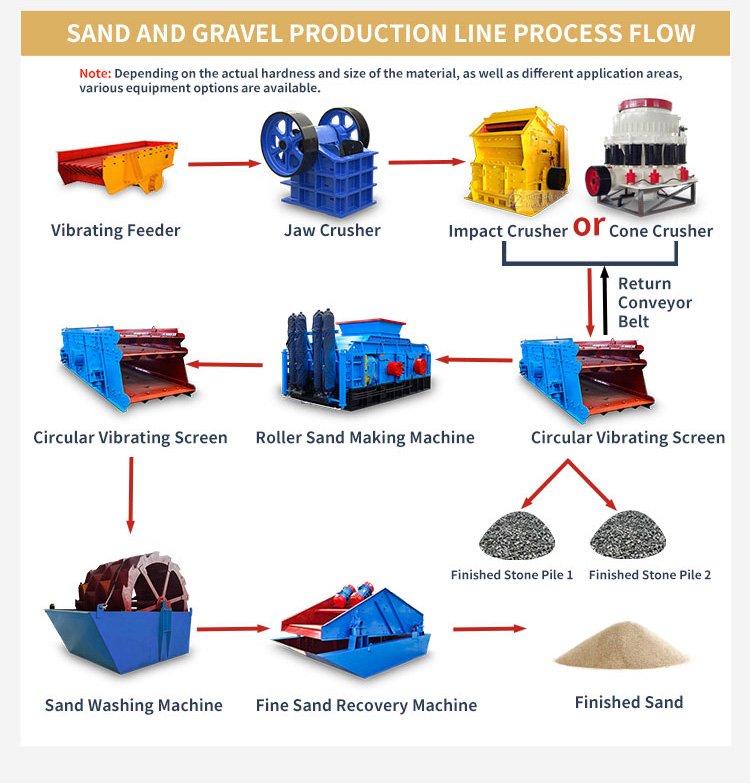
Multi-Stage Granite Crushing & Sand-Making Plant Flowsheet
4. Recommended Operational Practices for Granite Lines
Double roll crushers should never be operated as standalone “brute-force” reduction units on hard rock; multi-stage crushing is mandatory:
Standard Proven Granite Flowsheet:
Vibrating Feeder $rightarrow$ Jaw Crusher (Primary Coarse Reduction) $rightarrow$ Cone Crusher / Impact Crusher (Secondary Medium Reduction, Optional) $rightarrow$ Double Roll Crusher (Fine Reduction & Shaping) $rightarrow$ Circular Vibrating Screen (Grading & Closed-Circuit Return) $rightarrow$ Sand Washing Machine / Dust Collection System.
- Delegate Coarse and Medium Reduction: Keep feed entering the roll crusher strictly within allowable size limits, allowing roll gaps to remain tight and shell wear to distribute evenly.
- Incorporate Closed-Circuit Screening: Route oversized particles back for re-crushing rather than forcing tight roll gaps, ensuring stable top-size limits without sacrificing throughput.
- Equip High-Chromium Wear Shells: Granite’s strong abrasiveness makes roller shells the primary consumable; matching high-chromium alloy metallurgies offers superior durability compared to frequent part replacements.
5. Frequently Asked Questions
Q: Can double roll roller shells withstand granite’s extreme hardness?
A: Yes, but plant operators should note that granite’s high abrasiveness causes faster shell wear than limestone. Mitigation relies on high-chromium wear alloys, proper primary coarse reduction, and modular shell replacements. Total consumable costs remain lower than VSI thrower tip consumption.
Q: Are double roll crushers unsuited for high-tonnage output requirements?
A: Not at all. High-capacity plants deploy multiple double roll units in parallel to balance fineness and throughput while enabling scheduled maintenance rotation. Huashengming hydraulic series models achieve high single-unit capacities for large-scale quarries 【Custom Parameters Available】.
Q: Can granite sand lines produce premium commercial sand?
A: Absolutely. The particle shape advantages of double roll crushers align perfectly with premium sand specifications. Specific fineness and powder percentages require engineering verification based on project samples and targets.
6. Four Parameters Needed for Custom Engineering Proposals
To receive an accurate quotation and plant configuration, please provide:
- Maximum Granite Feed Lump Size: (ROM top-size entering the circuit)
- Target Finished Gradation & Screening Mesh Specs: (e.g., 0–5mm manufactured sand)
- Expected Hourly Capacity: (Tons per hour target)
- Upstream Equipment Status: (Whether primary coarse crushers exist, or if a complete turnkey line is required)
Providing these four metrics allows Huashengming to specify exact equipment models, roll dimensions, motor power ratings, roller surface metallurgies, and complete line layout drawings 【Custom Parameters Available】. Referenced capacities are process guidelines; performance parameters are governed by official project customization agreements.
Want to Design the Most Cost-Effective Granite Sand-Making Line?
Contact Huashengming Heavy Industry today for factory-direct inventory, customized engineering solutions, and on-site operational videos from active granite sand plants 【Custom Parameters Available】.
Global shipping support for domestic projects as well as installations across Southeast Asia, Africa, and international markets!