One of the most frequent questions from aggregate and mineral sand producers is whether a double roll crusher generates excessive stone powder. Compared to hammer crushers, impact crushers, and VSI sand makers, double roll crushers produce significantly fewer fines due to their low-speed static compression principle. However, zero powder is impossible—final powder percentage depends on rock friability, roller condition, and operational settings. This article details the root causes of powder spikes, equipment comparisons, and five proven adjustments used on Huashengming (HSM) Heavy Industry roll crushers to keep fines strictly under control.
One-sentence conclusion: Compared to hammer crushers, horizontal impact crushers, and VSI sand makers, a double roll crusher produces far less fine powder; however, it does not produce zero powder—final fines content depends on raw material properties, machine configuration, and parameter tuning. Because a double roll crusher relies on static inter-roller pressure rather than high-speed repeated impact and attrition, rocks fracture cleanly along their natural cleavage planes, drastically minimizing over-crushing at the mechanical source [Custom Parameters Available].
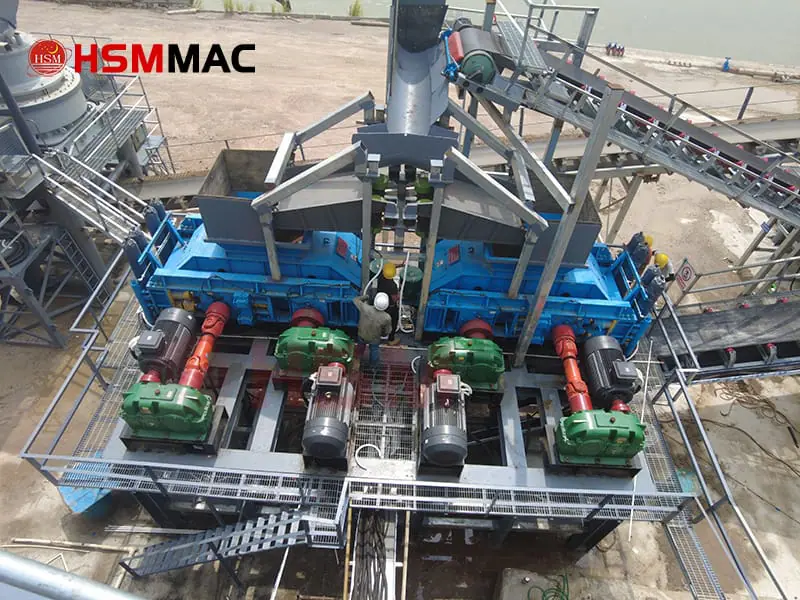
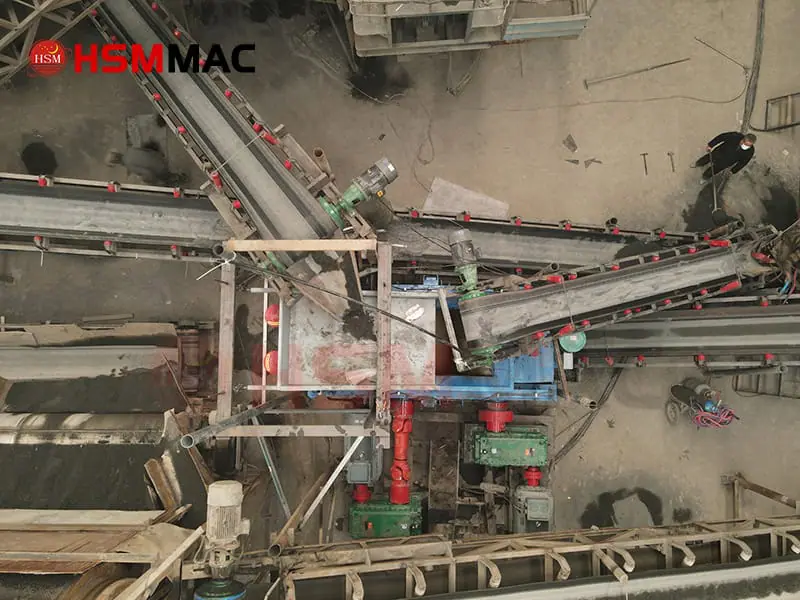
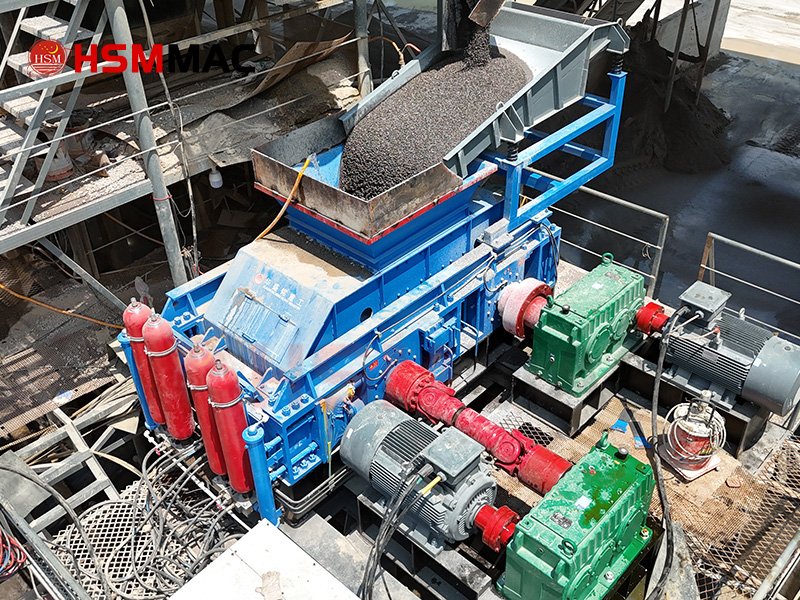
HSM Heavy-Duty Double Roll Crusher Producing Low-Fines Manufactured Sand
1. Why Double Roll Crushers Generate Less Stone Powder
Huashengming (HSM) heavy-duty double roll crushers feature precision-machined alloy roll shells that maintain parallel, uniform inter-roller gaps across the entire crushing width. When processing river pebbles, quartz, granite, or limestone into sand, finished grains remain rounded and cubical with low needle-flake percentages and tightly controlled fine powder ratios—ideal for high-grade concrete sand, premium aggregates, and fine ore preparation ahead of beneficiation [Custom Parameters Available].
2. Five Factors That Can Still Increase Powder Output
- Overly Tight Roll Gap: Setting the inter-roller gap too narrow forces already-crushed particles to undergo repeated compression and attrition, driving fine powder percentages sharply upward.
- Oversized Feed Top Size: Feeding boulders larger than the allowable nip angle causes rocks to stall and skid against the rotating shells, continuously grinding material into dust.
- Uneven Feed Distribution: Concentrated or off-center feeding causes localized material buildup and slippage along the roller face, resulting in frictional powder generation.
- Severely Worn Roll Shells: Deeply grooved or uneven roller surfaces create inconsistent discharge gaps across the width, increasing localized over-grinding.
- Soft or Friable Rock Properties: Brittle sedimentary stones like limestone naturally yield slightly higher fine powder percentages than dense, tough igneous rocks like granite or river pebbles under identical machine settings.
3. Five Practical Adjustments to Keep Fines Within Target Limits
- Set the inter-roller gap realistically according to target gradation curves rather than over-tightening for ultra-fine output.
- Install an upstream vibrating screen to strictly cap maximum feed size and prevent oversized lumps from entering the chamber.
- Use a full-width feed distributor to spread material evenly across the entire roller face, eliminating off-center slippage.
- Select variable-frequency drive (VFD) models where applicable; lower peripheral roll speeds promote pure static compression and minimize powder generation.
- Inspect roller surfaces regularly and perform timely hardfacing weld repairs or segmented shell replacements to maintain parallel gap geometry.
4. Sand Making Equipment Comparison: Fines & Particle Shape
| Crusher Type | Fine Powder Level | Best-Fit Application Scenario |
|---|---|---|
| HSM Double Roll Crusher | Low & Controllable | Ideal when low fines, rounded cubical grains, and high sand yield are required |
| VSI Impact Sand Maker | Moderate to High | Good grain shape, but generates higher stone dust and rapid wear on hard rock |
| Hammer Crusher | Highest (Severe Over-Crushing) | Suitable only when high stone powder output is intentionally desired |

Uniform Cubical Sand Samples Produced by HSM Double Roll Crusher
5. Frequently Asked Questions (FAQ)
- Q: Does a double roll crusher produce zero stone powder?
A: No mechanical crusher produces zero fines. However, HSM double roll crushers keep fine powder content significantly lower than impact or hammer crushers, typically keeping <0.075 mm stone powder well within standard concrete sand limits when operated in closed circuit with screening. - Q: What should I do if my double roll crusher suddenly starts producing more powder?
A: First check whether the discharge gap was closed too tightly, verify that upstream screen meshes are intact so oversized boulders are not slipping on the rollers, and inspect the roll shell surface for uneven center grooving. - Q: Is a double roll crusher suitable if my downstream process requires high amounts of ultra-fine powder?
A: No. Double roll crushers are designed specifically to prevent over-crushing and preserve granular integrity. If your process requires high volumes of fine powder, a hammer crusher or grinding mill is a better fit [Custom Parameters Available].
Want to Control Stone Powder and Maximize Qualified Sand Yield?
Huashengming Heavy Industry offers raw material sample testing and custom parameter matching—tuning roller surface profiles, peripheral speeds, and hydraulic gap configurations to deliver clean, rounded sand with minimal over-crushing [Custom Parameters Available]!
Contact our engineering team today for factory-direct inventory, technical consultations, and global shipping support!