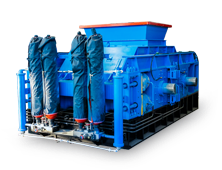
Manufactured sand (M-sand) production requires producing a graded product finer than 5mm while satisfying strict particle shape and fines content specifications. The double roll crusher is not merely an alternative; for small-to-mid-size operations, it represents the lowest-lifetime-cost sand-making machine. This article details how roll press comminution achieves cubical, low-fines M-sand, compares performance against vertical shaft impactors (VSI), outlines plant circuit placement, and presents the reference model range from Huashengming (HSM) Heavy Machinery.
Can a roll crusher make manufactured sand? Yes—and here is when it represents the best engineering choice. Manufactured sand (M-sand) is produced by reducing quarry rock into a graded product finer than 5text{mm}. Two machinery families dominate this field: vertical shaft impactors (VSI) and static compression machines—the double roll crusher. Using a double roll crusher for sand making is not a compromise; for a specific and very common set of plant requirements, it is the superior machine.
In short: a double roll crusher yields cubical, low-fines manufactured sand from medium-to-hard rock at significantly lower electrical power costs, with gradation easily adjusted via inter-roll gap clearance. This combination makes it exceptionally attractive for small and mid-size sand plants, as well as for producers whose clients penalize poor particle shapes or excessive stone dust.
Note: Capacity and gradation figures in this article are indicative; final equipment selection is confirmed against your specific rock type and target sand specifications 【Custom Parameters Available】.

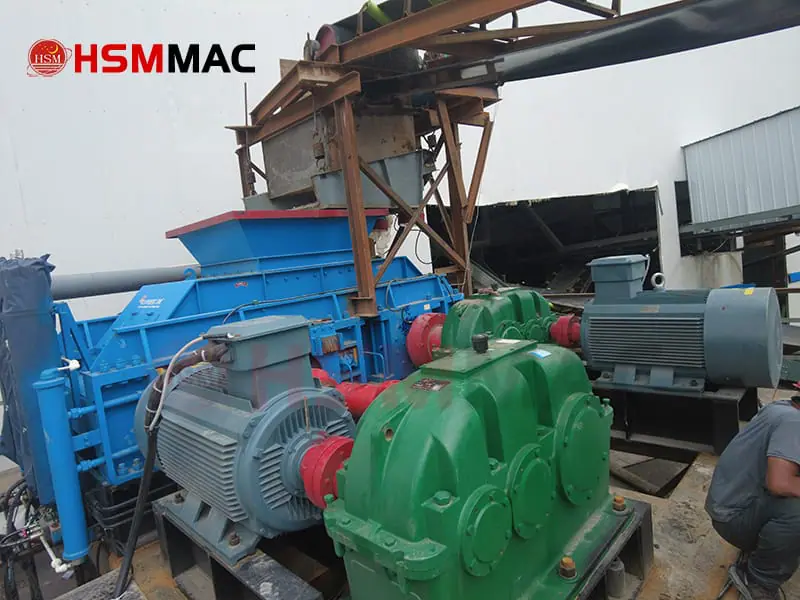
HSM Double Roll Crusher Operating in an M-Sand Plant
1. How the Roll Crusher Performs on Key M-Sand Quality Criteria
- Cubical Particle Shape & Low Flakiness: Concrete batching plants test particle shape because flat, elongated, or angular grains increase water and cement paste demand. Compression crushing fractures rock along natural mineral grain boundaries, producing cubical and near-cubical grains with a low flakiness index—delivering excellent concrete workability without added cement costs 【Custom Parameters Available】.
- Controlled Fines Content (Minimal Over-Crushing): The most common complaint regarding M-sand is excessive, uncontrolled stone powder. A roll crusher operates on a “crush-to-size-and-exit” principle: material discharges as soon as it reaches the inter-roll gap, keeping fine powder generation low by design.
- Adjustable Gradation Without Changing Parts: Sand specifications are defined by fineness modulus (FM) and grading curves. On a double roll crusher, adjusting the inter-roll gap regulates the output size—allowing coarse sand, medium sand, or finer gradations to be produced on the same machine without swapping out internal wear parts or screens.
- Lower Energy Cost Per Ton of Sand: Low-speed compression comminution eliminates high-speed rotor windage and kinetic impact losses, resulting in a lower specific energy consumption (kWh/t). Energy represents a primary operational cost for sand plants; these savings compound across every operating hour.
- Moisture & Sticky Feed Tolerance: High surface moisture causes impact crushers and screens to blind rapidly. Roll crushers tolerate moist and slightly sticky feeds—a major practical advantage in river pebble operations or humid tropical environments where washing water is present.
2. Where the Roll Crusher Sits in an M-Sand Plant
Proven Plant Flowsheet:
Vibrating Feeder rightarrow Jaw Crusher (Primary) rightarrow Cone Crusher (Secondary) rightarrow Double Roll Crusher (Sand Making / Shaping) rightarrow Circular Vibrating Screen rightarrow Sand Washer (Optional) rightarrow Product Sand.
Two Crucial Configuration Guidelines:
- Feed Properly Prepared Material: Double roll crushers function as fine-reduction and shaping units. Primary jaw and secondary cone stages must reduce feed lump dimensions to within the roll crusher’s allowable feed limit (25–120mm depending on model) 【Custom Parameters Available】.
- Close the Circuit with a Vibrating Screen: Route oversized material back for re-crushing. Screen recirculation—rather than forcing roll gaps to extreme minimums—is the correct engineering method to lock down top sizes without sacrificing throughput.
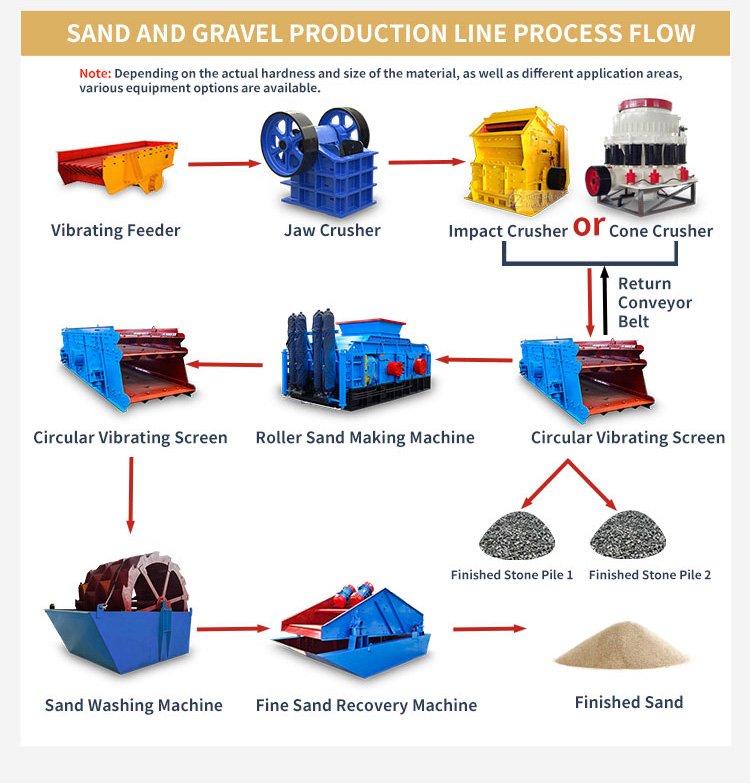
Flowchart of the Artificial Sand Production Process
3. Model Range for Sand Making (Reference)
| Model Designation | Roll Diameter (mm) | Max Feed Size (mm) | Capacity (T/H) |
|---|---|---|---|
| 2PGT400×400 | 400 | 25 | 5–12 |
| 2PGT610×400 | 610 | 30 | 5–20 |
| 2PGT750×500 | 750 | 30 | 10–40 |
| 2PGY800×1000 | 800 | 40 | 50–80 |
| 2PGY1200×1200 | 1200 | 60 | 120–150 |
| 2PGY1500×1200 | 1500 | 80 | 200–250 |
| 2PGY2000×1200 (Flagship) | 2000 | 120 | 300–400 |
4. Frequently Asked Questions
Q: Roll crusher or VSI for sand making?
A: They are complementary. VSI crushers dominate mega-scale single-line plants and ultra-fine sand specifications, but incur higher power and wear costs per ton. Roll crushers excel in particle shape control, low fines generation, energy efficiency, and operational simplicity for small and mid-size plants—especially when processing hard, abrasive rock where impact parts wear rapidly. Many plants select a Jaw \rightarrow Cone \rightarrow Double Roll Crusher circuit as the lowest-lifetime-cost sand line.
Q: Can roll crusher sand meet commercial concrete sand specifications?
A: Yes—cubical particle shapes and adjustable gradations align directly with concrete sand testing standards. Achievable gradation curves depend on your rock feed and target specs; provide your rock type and spec sheet for exact engineering calculations 【Custom Parameters Available】.
Q: How is stone powder content managed in M-sand?
A: Roll crushing inherently generates less stone powder than high-speed impactors. Where a specific powder percentage is required, controlled dust return or downstream sand washing units manage the final content to exact specifications.
Q: What roll surface options are available?
A: Smooth roll shells suit hard, clean feeds requiring tight top-size limits; toothed roll shells suit sticky, moist, or slabby feed material. We match roll face metallurgies and geometries to your specific rock type 【Custom Parameters Available】.
5. Size Your Sand Plant With Four Data Points
To receive a precise engineering proposal and quotation for an M-sand line, please provide:
- Rock Type & Compressive Hardness: (e.g., granite, basalt, limestone, river pebbles)
- Feed Top Size to Roll Crusher: (Pre-crushed feed top size)
- Target Sand Specification: (Fineness modulus / grading curve requirements)
- Design Capacity: (Tons per hour target)
Providing these four metrics allows Huashengming to specify exact equipment models, motor ratings, and roll surface configurations 【Custom Parameters Available】.
Referenced process descriptions serve as engineering guidelines; specific performance parameters are governed by official project customization agreements.
Ready to Build a High-Efficiency M-Sand Line?
Huashengming Heavy Machinery offers factory-direct inventory, rapid dispatch, and roll surface solutions tailored to your rock feed 【Custom Parameters Available】.
Site videos and M-sand plant operational references for Southeast Asian and African projects available upon request!