Achieving a consistent 400 T/H (tons per hour) in heavy-duty aggregate and mineral processing requires selecting the optimal equipment configuration. This article provides a definitive model selection guide, recommending the flagship Huashengming (HSM) 2PGY2000×1200 hydraulic double roll crusher or an alternative dual-unit parallel layout (2 × 2PGY1500×1200) for enhanced maintenance redundancy. The piece details large-scale model matrix specifications, hydraulic tramp protection, closed-circuit plant flowsheets, and essential parameters required for custom engineering proposals.
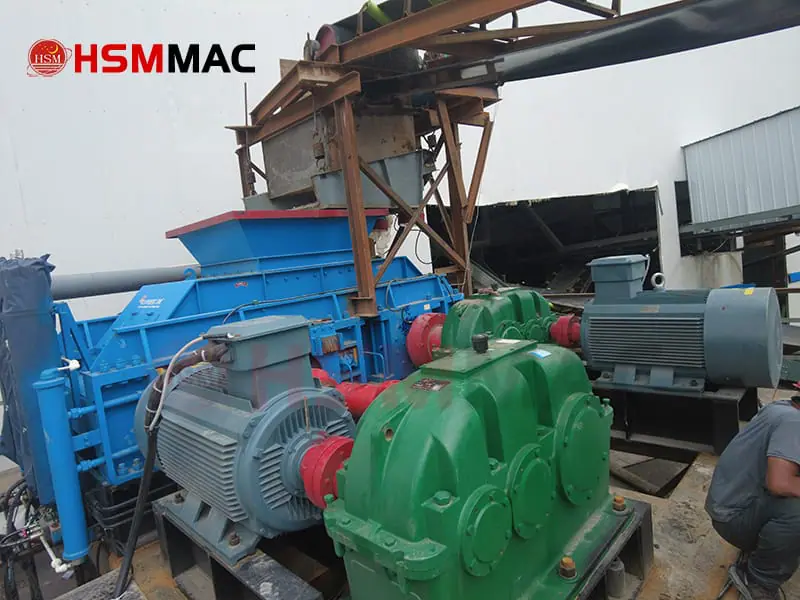
Direct conclusion: Choose the 2PGY2000×1200. Achieving a steady 400 T/H falls into heavy-duty industrial processing. Within Huashengming’s comprehensive double roll crusher lineup, the model engineered to reliably cover this capacity tier is the 2PGY2000×1200 hydraulic double roll crusher—featuring a roll diameter of 2000text{mm}, a roll width of 1200text{mm}, an allowable feed size up to 120text{mm}, a nominal capacity of 300–400 T/H, and a robust dual-motor drive system.
If your project demands high capacity redundancy and continuous operational flexibility, the recommended alternative is a dual-unit parallel configuration using two 2PGY1500×1200 units (each rated at 200–250 T/H). This setup achieves the same 400 T/H cumulative output while allowing one unit to undergo scheduled maintenance without halting the entire production line.

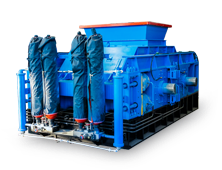
HSM 2PGY2000×1200 Heavy-Duty Hydraulic Double Roll Crusher
1. Why the 2PGY2000×1200 Is the Flagship Choice
- 1. Operating at the Top of the Working Range (Not the Absolute Limit): Running any crusher at its maximum ceiling is poor engineering practice—feed surges or harder ore veins will immediately drag output down. The 2PGY2000×1200 is rated at 300–400 T/H, positioning 400 T/H at the upper boundary of its working range. When paired with stable volumetric feeding and proper roll gap settings, it runs reliably; however, for round-the-clock continuous production where feed uniformity cannot be guaranteed, the dual-unit parallel layout is recommended to secure operational buffers.
- 2. Large Roll Diameter Ensures Stable Biting: The 2000\text{mm} rolls accept feed up to 120\text{mm} with a deep, stable nip angle. This prevents material slippage, minimizes flat-plate rejects, and ensures uniform product gradation even at high throughput rates. In large-scale operations, maintaining feed stability against material variations is paramount.
- 3. Hydraulic Protection Against Tramp Iron: 400 T/H crushing lines typically process material fed by heavy-duty mining excavators and loaders, making the introduction of stray excavator teeth, drill steel fragments, or liner plate remnants nearly inevitable. High-response hydraulic relief systems allow movable rolls to retract instantly to pass tramp metal and reset automatically, protecting roll shells and main shafts while preventing costly unplanned shutdowns.
- 4. Adjustable Sizing & Minimal Fines Generation: Inter-roll gap clearance governs product top sizes. The low-speed “sufficiently crushed, immediately discharged” compression logic generates minimal over-grinding. For concentrators, this reduces downstream ball mill workloads (“more crushing, less grinding”); for aggregate plants, it maximizes qualified yield and minimizes discounted undersize material.
2. Two Engineering Strategies for 400 T/H Plants
| Configuration Strategy | Engineering Characteristics | Ideal Application Environment |
|---|---|---|
| Plan A: Single Unit (2PGY2000×1200) |
Lower capital investment, compact footprint, simplified single-point electrical and mechanical control. | Stable raw feed supply, flexible scheduled maintenance windows, and standard hard-rock high-chrome roll metallurgy 【Custom Parameters Available】. |
| Plan B: Dual Parallel Units (2 × 2PGY1500×1200) |
Each unit rated at 200–250 T/H; combined capacity reaches 400 T/H with ample operating headroom. One unit can service maintenance while the second continues running at reduced load. | High-continuity industrial concentrators and large-scale quarries where unplanned production downtime carries heavy financial penalties. |
3. Large-Scale Model Reference Table
| Model Designation | Roll Diameter (mm) | Max Feed Size (mm) | Capacity (T/H) |
|---|---|---|---|
| 2PGY1200×1200 | 1200 | 60 | 120–150 |
| 2PGY1500×1000 | 1500 | 80 | 150–200 |
| 2PGY1500×1200 | 1500 | 80 | 200–250 |
| 2PGY1800×1000 | 1800 | 100 | 250–300 |
| 2PGY2000×1200 (Flagship) | 2000 | 120 | 300–400 |
Selection Rule: Choose a model whose mid-range capacity covers your operational target, rather than one whose absolute ceiling equals it. A 400 T/H requirement is perfectly matched by the 2PGY2000×1200 (top-range coverage) or a dual 2PGY1500×1200 parallel arrangement (mid-range coverage with redundancy) 【Custom Parameters Available】.

400 T/H Heavy-Duty Crushing Plant
4. Typical 400 T/H Plant Flowsheet Configuration
Standard Proven Flowsheet:
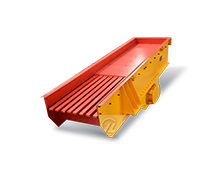
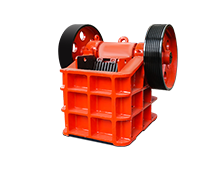
Vibrating Feeder rightarrow Jaw Crusher (Primary Coarse Reduction) rightarrow Cone Crusher (Secondary Medium Reduction) rightarrow 2PGY2000×1200 Double Roll Crusher (Tertiary Fine Crushing) rightarrow Circular Vibrating Screen (Closed-Circuit Oversize Return Loop) rightarrow Finished Product / Ball Mill Feed.
Two Critical Engineering Rules:
- Strict Feed Size Control: Double roll crushers function as fine-reduction machinery. Raw feed top size must be controlled upstream by primary jaw and secondary cone crushers to within the allowable feed limit ( 120text{mm}), preventing the roll crusher from handling coarse reduction tasks.
- Enforce Closed-Circuit Screening: Routing crushed material across vibrating screens with oversized particles returned for re-crushing maintains stable top-size limits without forcing roll gaps to extreme minimums that sacrifice throughput capacity.
5. Four Essential Parameters for Accurate Sizing
To receive a precise engineering quotation and plant configuration for a 400 T/H line, please provide:
- Material Type & Compressive Hardness: (e.g., iron ore, copper ore, granite, limestone, river pebbles)
- Maximum Feed Lump Dimensions: (Top-size entering the double roll stage)
- Target Finished Gradation or Mill Feed Sizing: (Required output grading specs)
- Capacity Requirement: (Stable continuous 400 T/H operating tonnage vs. peak capacity targets)
Providing these four details allows Huashengming to specify exact equipment models, motor ratings, roll surface metallurgies, and complete line layout drawings 【Custom Parameters Available】.
Referenced capacities are nominal engineering guidelines; actual output varies based on material hardness, moisture, and feed/discharge specs, governed by formal project customization agreements.
Need a Quotation or Plant Layout for a 400 T/H Crushing System?
Contact Huashengming Heavy Industry today for factory-direct inventory, rapid dispatch, and customized engineering schemes 【Custom Parameters Available】.
Reliable global shipping for domestic projects, Southeast Asia, Africa, and international destinations!