Direct Answer & Equipment Matching Logic:
- Not Recommended for Direct Large Feeds: Double roll crushers are designed for secondary and fine crushing. Maximum allowable feed size is strictly constrained by the roller diameter and nip angle geometry.
- Two-Stage Circuit Strategy: Large run-of-mine (ROM) boulders should first enter a heavy-duty Jaw Crusher (Primary) before passing to the Double Roll Crusher (Secondary) for uniform sizing.
- Operational Benefits: Matching feed sizes prevents roller face gouging, motor overloads, and unexpected downtime, ensuring lower wear costs per ton.
Many plant operators ask whether a double roll crusher can process large run-of-mine (ROM) rock directly to save on initial capital investment. The short answer is: it is generally not recommended. Double roll crushers serve primarily as secondary, tertiary, or fine sand-making units. Forcing large boulders into roll machinery causes severe slippage, accelerated roller shell wear, and potential motor stalling. Matching feed sizes across a Primary Jaw Crusher → Secondary Double Roll Crusher circuit is key to long equipment life and predictable output.
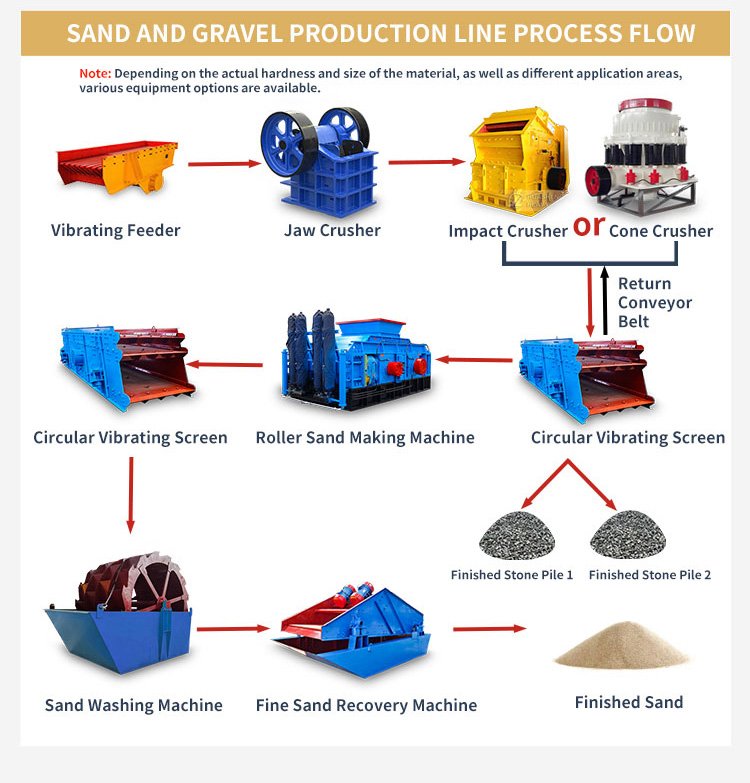
Process diagram illustrating Vibrating Feeder → Jaw Crusher → Conveyor → Double Roll Crusher → Vibrating Screen.
1. Why Double Roll Crushers Are Not Designed for Oversized Feeds
Understanding mechanical nip limits explains why oversized feeds damage roll crushers:
- Nip Angle Limitations: The ability of counter-rotating rollers to grip a rock depends on the nip angle (typically 16°–24°). When rock size exceeds ~5% to 10% of roller diameter, the rock bounces on top rather than entering the crushing zone.
- Accelerated Wear & Spot Surface Damage: Oversized rocks resting on spinning rollers cause continuous localized friction, carving grooves into the alloy shell and reducing overall service life.
- Frequent Overload Trips: Forcing large rocks forces dynamic hydraulic cylinders to repeatedly bypass, creating erratic product sizes and high power spikes.
2. Recommended Two-Stage Crushing Process Flow
• Primary Stage: Jaw Crusher (Large Ore Opener)
Accepts raw mine boulders up to 500–1000mm, reducing them down to manageable intermediate sizes (<100–150mm) with high impact resistance.
• Secondary / Fine Stage: Double Roll Crusher (Controlled Sizing)
Receives pre-crushed feed from the jaw crusher, delivering high-pressure inter-particle squeeze crushing with adjustable gap controls for fine aggregate or sand.
• Auxiliary Stage: Vibrating Screen & Closed-Circuit Return
Screens output fractions. Oversize particles return to the double roll crusher in a closed loop, ensuring 100% size compliance for finished product.
3. How to Match Feed Size with Equipment Selection
| Feed Size / Condition | Recommended Equipment Route | Operating Outcome |
|---|---|---|
| Raw ROM Boulders (>200mm) | Jaw Crusher (Primary) → Double Roll Crusher (Secondary) | Smooth operation, high throughput, minimal roller wear. |
| Medium Feed (<50–100mm) | Heavy-Duty Large Diameter Double Roll Crusher (Direct Feed) | Direct feed possible provided feed size < 5% of roller diameter. |
| Fine Aggregate Feed (<20–30mm) | Double Roll Sand Maker / High-Pressure Grinding Roll | Optimal fine sand production, uniform cubical grain shape. |

HSM Double Roll Crusher
4. Huashengming (HSM) Selection & Custom Engineering
- Tailored Equipment Selection: We calculate exact feed limits based on your site’s maximum rock dimensions and targeted hourly output.
- Customizable Technical Parameters: Adjustable roller shell widths, drive motor ratings, and hydraulic gap mechanisms available upon request 【Custom Parameters Available】.
- In-Stock Equipment Delivery: Standard Jaw Crushers and Double Roll Crushers are maintained in stock for prompt factory dispatch.
- Free Sample Material Testing: Send raw material samples to Huashengming for free teststand trials to verify nip angle performance and screen sizing.
Standard Recommended Circuit: Vibrating Feeder → Jaw Crusher (Primary) → Double Roll Crusher (Secondary) → Vibrating Screen.
Contact Huashengming for custom circuit parameters and free sample crushing trials.